

Skill Align VCE English Units 3&4 - Free Online Pack 0
A complete independently authored three-section examination available for browser viewing.
- Paper
- Task and Response Book
- Reading
- 15 minutes
- Writing
- 3 hours
- Assessment
- 60 marks
Approved materials: Pens, pencils, highlighters, erasers, sharpeners, rulers, and an English and/or bilingual printed dictionary. Materials supplied: This combined Task and Response Book. Instructions: Write all responses in English in this book. Complete one response in each of Sections A, B and C. Each section is worth 20 marks; total 60 marks. Mobile phones and unauthorised electronic devices are not permitted.
Section A - Analytical response to a text
Select one text from the 2026 VCE English and English as an Additional Language Text List and respond to one topic for that text. Your response should engage with the ideas, concerns and values raised by the topic and support your analysis with close reference to the text. If your selected text is a collection of poetry or short stories, you may write on several poems or stories, or on at least two in close detail.
Question 1
20 marks2026 List 1 - original Skill Align Pack 0 topic choices
1. Regeneration by Pat Barker (i) What is the significance of Prior’s shifting social identity in Regeneration? OR (ii) Care in Regeneration becomes dangerous when it is treated as a command. Discuss.
2. Jane Eyre by Charlotte Brontë (i) "I am not an angel". Does Brontë require her heroine to be morally exemplary? OR (ii) How does Brontë distinguish solitude from genuine freedom?
3. My Brilliant Career by Miles Franklin (i) To what extent does My Brilliant Career distinguish artistic aspiration from a desire for status? OR (ii) Embarrassment challenges the social expectations Sybylla has absorbed. Discuss.
4. Chronicle of a Death Foretold by Gabriel García Márquez (i) Does Chronicle of a Death Foretold distinguish guilt from responsibility? OR (ii) Foreknowledge makes the novella’s fragmented chronology ethically unsettling. Discuss.
5. Orbital by Samantha Harvey (i) What does Orbital suggest about the value of a single day? OR (ii) Private grief does not disappear when it is placed beside planetary beauty. Discuss.
6. We Have Always Lived in the Castle by Shirley Jackson (i) What is the significance of inherited wealth in the Blackwood sisters’ isolation? OR (ii) How does Jackson use food to blur the boundary between nurture and threat?
7. Ghost Wall by Sarah Moss (i) Silvie learns that obedience can masquerade as historical authenticity. Discuss. OR (ii) How does Moss make spectatorship a form of responsibility?
8. The Memory Police by Yōko Ogawa (i) Does the ending of The Memory Police deny the value of love? OR (ii) The narrator’s changing language reveals the reach of disappearance. Discuss.
9. Bad Dreams and Other Stories by Tessa Hadley (i) What do Hadley’s stories reveal about the difference between possessing a memory and understanding it? OR (ii) How do domestic spaces expose conflicts that polite speech avoids?
10. The Complete Stories by David Malouf (i) To what extent does Malouf present kindness as an unexpected source of change? OR (ii) Physical vulnerability alters self-knowledge in Malouf’s stories. Discuss.
11. Rainbow’s End by Jane Harrison (i) Is the Dear family’s strength dependent on agreement? OR (ii) In what ways does the play make schooling a contested promise?
12. Twelfth Night by William Shakespeare (i) What is the significance of Feste’s freedom to move between households? OR (ii) How does performance permit truths that ordinary conversation suppresses?
13. Oedipus the King by Sophocles (i) Does Oedipus the King leave any room for a just outcome? OR (ii) How do pauses and delayed testimony control the tragedy's movement towards recognition?
14. Selected Poems by Langston Hughes (i) What is the significance of domestic aspiration in Hughes’s Selected Poems? OR (ii) How does rhythm convert disappointment into collective motion?
15. Selected Poems 1965–2005 / New and Selected Poems, Volume One by Mary Oliver (prescribed sections: Dream Work and American Primitive; either edition) (i) In Oliver's poetry, attention is a discipline rather than an escape. Discuss. OR (ii) How do the poems allow wonder and unease to coexist?
16. High Ground directed by Stephen Johnson (i) To what extent does High Ground ask viewers to distrust the perspective offered by its title? OR (ii) How does Johnson's framing make the land an active witness?
17. Sunset Boulevard directed by Billy Wilder (i) Is the relationship between Joe and Norma sustained more by fear than by affection? OR (ii) Wilder’s interiors reveal the distance between his characters and reality. Discuss.
18. Requiem for a Beast by Matt Ottley (i) What is the significance of the contrast between the protagonist’s self-image and his actions in Requiem for a Beast? OR (ii) How does the text's form require readers to move between personal and historical scales?
19. We Come with This Place by Debra Dank (i) Does Dank’s account of memory challenge the idea that knowledge belongs to one person? OR (ii) How does the narrative voice refuse a separation between knowledge and obligation?
20. Born a Crime by Trevor Noah (i) To what extent does Born a Crime invite readers to question the narrator’s younger self? OR (ii) A change of audience can make the same words dangerous in Born a Crime. Discuss.
Section B - Creating a text
Select one Framework of Ideas. Use its supplied title and at least one stimulus to create one written text, not including song, poetry or verse. Develop a clear purpose that incorporates at least one of the following: to explain, to express, to reflect or to argue. This section is worth 20 marks.
Question 1
20 marksFramework 1 - Writing about country Title: The Map That Would Not Fold Stimulus 1: "The river had revised the boundary before the ink was dry." Stimulus 2:
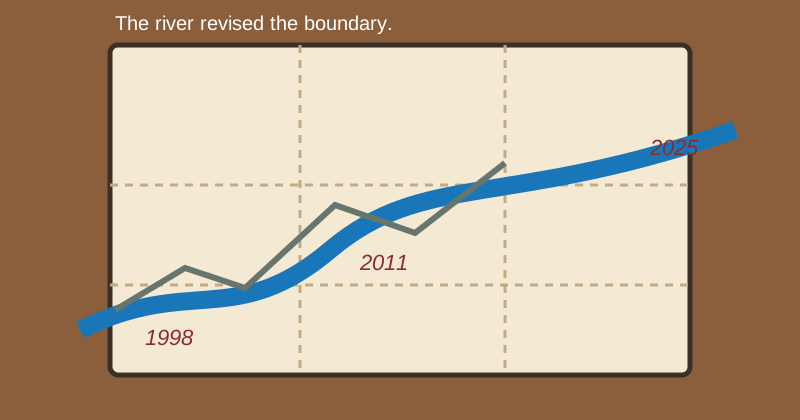
Stimulus 3: "Knowing a route is not the same as knowing what it asks you to carry."
Framework 2 - Writing about protest Title: Receipt for a Promise Stimulus 1: "We itemised every assurance because applause had made the earlier ones disappear." Stimulus 2:
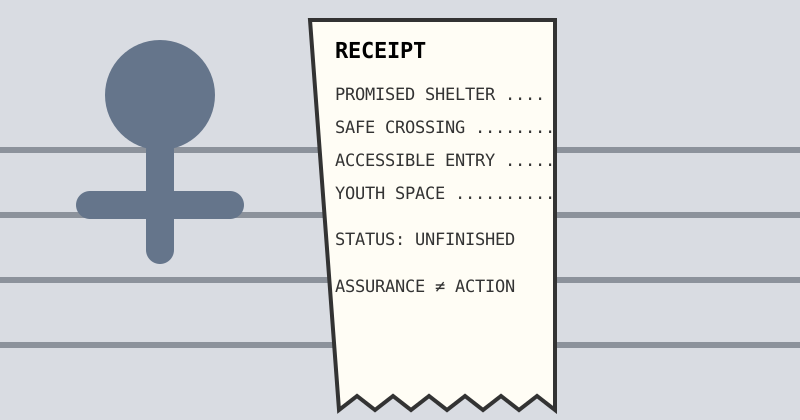
Stimulus 3: "A demand can be patient without becoming quiet."
Framework 3 - Writing about personal journeys Title: The Station After Mine Stimulus 1: "I stayed aboard to learn whether the mistake could become a destination." Stimulus 2:
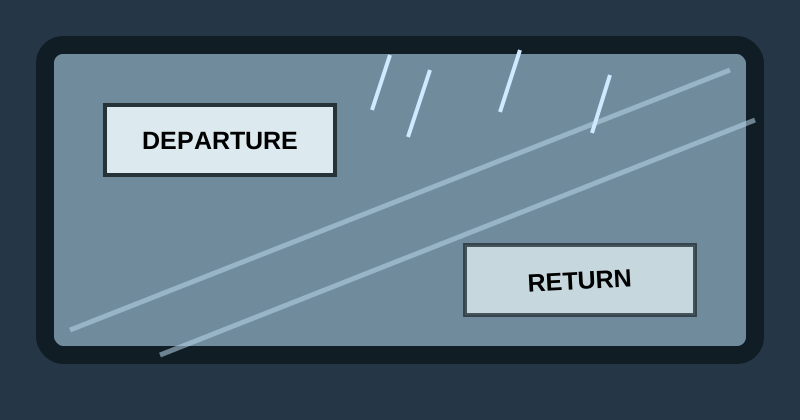
Stimulus 3: "The return trip began with a question I could not have asked when I left."
Framework 4 - Writing about play Title: Rules for the Invisible Team Stimulus 1: "We reserved one position for whoever invented the next rule." Stimulus 2:
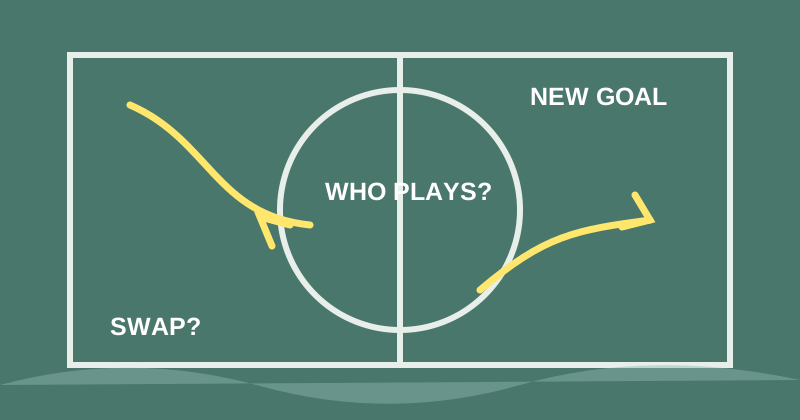
Stimulus 3: "The game became fair only when winning stopped being its sole ending."
Section C - Analysis of argument and language
Analyse how argument, written language and the accompanying cumulative-results chart are used to persuade the intended audience. This section is worth 20 marks.
Question 1
20 marksThe following scenario, organisations, people, data and persuasive material are fictional and created for this practice examination.
Background information Marlow Library is considering a six-month Saturday repair-bench trial in an unused seminar room. Residents would book broken household objects for assessment by trained volunteers. Electrical items would receive safety checks; unsafe or unrepairable objects would be referred to licensed services or the council's recycling depot. Asha Bell, who coordinates the neighbourhood shed and serves on the library advisory group, contributed the following article and chart to the library newsletter.
Give a broken thing one honest chance by Asha Bell, Marlow resident
My father's green desk lamp stopped working two months after he died. I kept it in a cupboard for seven years, not because it was valuable, but because throwing it away felt like making a second decision about losing him. When a retired electrician at the neighbourhood shed replaced one brittle cord and tested the lamp, the repair took twenty minutes. The light was ordinary. The chance to use it again was not.
Marlow Library should offer more residents that chance by approving a six-month Saturday repair bench. This is not a promise that every toaster, jacket or toy can be rescued. It is a practical place to ask three better questions before disposal: What failed? Can it be made safe? If not, where should it go next?
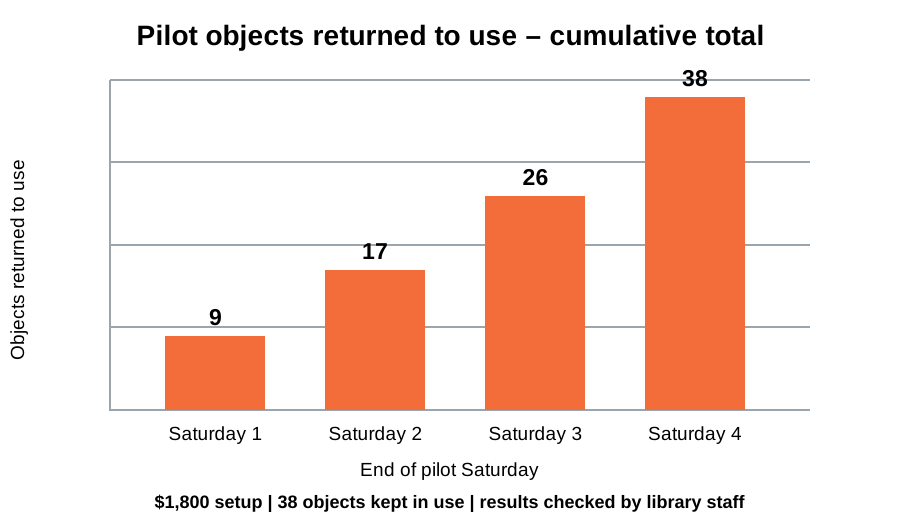
A four-Saturday pilot in the neighbourhood shed returned thirty-eight objects to use. The chart beside this article is deliberately cumulative: nine objects by the first Saturday, seventeen by the second, twenty-six by the third and thirty-eight by the fourth. Those figures do not prove what a larger library program will achieve. They do show that residents kept arriving with repairable problems once a visible, trusted place existed.
The library is the right setting because it already helps people find reliable information without requiring them to buy something. A repair bench extends that purpose from pages to objects. Volunteers will explain the fault and the limits of any repair while owners remain present. Nobody will leave an item for an unknown person to fix in private. Knowledge will be shared across the table, not hidden behind a counter.
Safety must be more than a reassuring word. The proposal separates tasks into three levels. Sewing, simple fastening and non-powered toys can be assessed by general volunteers. Mains-powered items can be opened only by volunteers with current electrical qualifications and must pass a recorded safety test before use. Gas appliances, damaged batteries, pressurised equipment and anything outside the team's competence will not be repaired. A clear refusal can protect a resident better than an enthusiastic guess.
Some local repair businesses reasonably ask whether a free bench will take paid work from them. The pilot suggests a different relationship. Eleven objects were referred to licensed trades because the fault required parts, certification or workshop equipment. The trial page will list participating local services, and volunteers will never quote for commercial work. By helping residents distinguish a loose screw from a failed motor, the bench can direct serious jobs towards the right expertise.
The six-month setup costs $1,800 for insulated tools, storage, protective equipment and safety testing. The seminar room is otherwise empty on Saturday mornings. Council will publish monthly figures for objects repaired, referrals, refusals, volunteer hours and repeat faults. At month three, library staff will survey participants and nearby repairers. At month six, council can stop, revise or continue the program with evidence in front of it.
Repair is sometimes described as nostalgia, as though people who mend things are refusing modern life. I think it is the opposite. Repair asks us to look closely at how an object was made, what skill is needed now and when replacement is genuinely safer. It respects memory without pretending memory can solder a wire.
Approve the trial. Bring the lamp, hem, radio or wooden truck that has been waiting in a cupboard. It may return home useful. It may leave with an honest explanation and a safe destination. Either result is better than treating uncertainty as rubbish.
Accompanying chart
Sample Responses And Practice Marking Guidance
Section A Question 1
Sample choice: Text 7, Ghost Wall, topic (ii)
In Ghost Wall, watching is never merely passive. Sarah Moss places Silvie among adults, students and visitors who repeatedly see fragments of Bill's coercion but understand them through different habits of attention. The novel therefore turns spectatorship into an ethical test: observation creates responsibility only when a witness is prepared to question the story that makes violence appear normal.
Silvie begins as the person most practised at watching. She monitors her father's moods, the distance between his body and hers, and the moment when enthusiasm for historical reconstruction becomes a command. This vigilance protects her in small ways, yet it also reveals how completely fear has organised her perception. She notices danger before others because she has had to learn its signs. Moss confines the narration to Silvie's perspective, making readers share both her accuracy and her reluctance to name what she sees. The result is uncomfortable: recognising coercion is not identical to being free to oppose it.
The experimental settlement gives Bill an audience that initially strengthens him. Professor Slade treats the recreation as serious inquiry and is attracted to the authority of hardship. The students see Silvie's father as an eccentric source of practical knowledge. Their interest allows Bill to perform command as expertise. When he corrects food gathering, clothing or behaviour, the group's curiosity gives his rules a public stage. Moss shows that spectators can intensify power when they interpret domination as authenticity.
Molly's attention works differently. She notices Silvie as a contemporary young woman rather than as part of the experiment's scenery. Her questions about food, privacy and Bill's demands interrupt the language of prehistory that has protected his conduct from ordinary judgement. Molly does not immediately understand the full danger, and some of her confidence reflects freedoms Silvie does not possess. Nevertheless, her willingness to find the arrangement strange gives Silvie another possible account of her life.
The bog body and the imagined wall extend the problem beyond one household. The group wants the past to become visible, but its chosen rituals risk converting suffering into spectacle. As the men move towards a staged sacrifice, the observers can no longer claim that reconstruction is harmless because nobody intended literal violence. Moss makes the scene frightening through its gradualness: gestures already rehearsed in domestic control acquire communal permission.
Silvie's mother has the most painful form of spectatorship. She reads Bill's temper and tries to reduce harm through compliance, food and careful timing. Her knowledge is intimate, but the strategies that help the family survive also leave the structure of violence intact. Moss does not present this as simple approval. Instead, she shows how responsibility is constrained by fear while refusing to make fear erase consequence.
By positioning readers inside Silvie's watchfulness, the novel removes the comfort of distant judgement. We see the warning signs, the rationalisations and the points at which another character might act. Spectatorship becomes responsible when it challenges the frame through which harm is being viewed. In Ghost Wall, the crucial question is not whether violence can be seen, but whether those who see it will allow knowledge, tradition or family loyalty to rename it.
Sample choice: Text 7, Ghost Wall, topic (ii). The response examines how observation becomes an ethical test rather than a neutral position.
Skill Align practice marking guidance — not the official VCAA marking method
Award one holistic mark out of 20. VCAA assessors use the published assessment criteria and interconnected Expected Qualities holistically; fixed criterion submarks are not totalled. The descriptors below are a Skill Align practice aid only.
Interpretation and text knowledge
Consider the accuracy, depth and complexity of the response's interpretation of the selected text and topic, including its structure, ideas, concerns and values.
Analytical development
Consider how coherently the response develops analytical ideas and explains how the text constructs meaning in response to the topic.
Evidence and close reference
Consider how selectively and precisely evidence and close reference support and extend the analysis.
Coherence and language control
Consider the organisation, fluency, vocabulary and control of Standard Australian English across the sustained response.
Holistic marking bands
| Marks | Descriptor |
|---|---|
| 17-20 | Close and perceptive reading; a cogent, controlled and well-substantiated interpretation that explores complexity with precise expression. |
| 13-16 | Thoughtful and detailed reading; a sustained, coherent analysis supported by well-selected textual evidence and fluent expression. |
| 9-12 | Clear to adequate text knowledge; a relevant analysis supported by appropriate evidence with generally organised expression. |
| 5-8 | Basic or limited text knowledge; partial engagement with the topic and uneven analytical development or language control. |
| 0-4 | Very limited relevant knowledge or engagement, with minimal analytical development and/or language control. |
Section B Question 1
The Map That Would Not Fold
The council map arrived in a plastic tube, smooth as a promise. According to its blue line, the creek stayed obediently behind the levee, curved past our road and entered the river without troubling anybody's kitchen.
Nan laughed when I unrolled it.
"Water hasn't read that," she said.
She opened the bottom drawer and took out her own map. It had once shown the same streets, but forty years of folding had divided it into soft squares. Pencil dates followed old flood lines across blocks coloured for housing. Some dates stopped at our back fence. Others reached the school oval, the bakery steps and the peppercorn tree that no longer stood beside the bridge.
I had come home as a graduate surveyor to help mark the new evacuation route. I wanted measurements, not family folklore. Nan's map seemed crowded with the imprecision I had been trained to remove: arrows labelled "fast here", a circle around "Mrs Tan's gate", a note that simply said "cows knew first".
Then she unfolded it once more.
A split ran through the paper near the creek. On either side, two pencil lines that should have met were separated by the width of a finger. Nan placed a salt jar on one corner and my coffee mug on another, but the map lifted between them as if the flood itself were trapped underneath.
"That's why it won't fold properly," she said. "Too many different years trying to lie in the same place."
We walked the proposed route after rain. The council plan directed residents east towards the highway. Nan stopped at a shallow dip I had recorded as a minor drainage crossing. She pointed to grass flattened against the fence, then to silt caught high in the wire.
"That fills before the siren," she said.
I checked the levels the next morning. She was right. The route remained legal on the model because the model averaged the creek across a large grid. At road height, water could cut the crossing before the official trigger was reached.
I did not replace the survey with Nan's pencil. I added gauges, checked rainfall records and walked the western track with the fire captain. But her marks told me where measurement had to become more precise. "Cows knew first" became a low paddock where runoff arrived from two directions. "Mrs Tan's gate" became the only wide opening on a raised section of road.
At the public meeting, I projected both maps. Mine sat flat on the screen. Nan's appeared with shadows along every crease.
A councillor asked which one was authoritative.
"They answer different questions," I said. "One predicts where water should move. The other records where people have already watched it go."
We changed the route. The new signs point west before joining the highway beyond the dip. Council installed a gauge at the paddock and added local observations to the annual review instead of waiting for a major flood to prove the model wrong.
Nan gave me her map when the signs went up. I tried to return it to the bottom drawer, but it resisted the old sequence of folds. At last I left it open on the kitchen table.
Some maps are made portable by hiding their creases. This one had become useful by refusing to forget them.
Sample selection: Framework 1, Writing about country; title: The Map That Would Not Fold; Stimulus 2. The sample uses a repeatedly opened flood map to explore inherited local knowledge and responsibility.
Skill Align practice marking guidance — not the official VCAA marking method
Award one holistic mark out of 20. VCAA assessors use the published assessment criteria and interconnected Expected Qualities holistically; fixed criterion submarks are not totalled. The descriptors below are a Skill Align practice aid only.
Framework, title and stimulus engagement
Consider how insightfully relevant ideas from one Framework of Ideas, the supplied title and at least one stimulus are integrated and developed.
Purpose and voice
Consider the clarity of purpose and the effectiveness and consistency of the voice and its relationship with an intended audience.
Craft, structure and cohesion
Consider how deliberately text structure, language features, vocabulary and development create an effective and cohesive text.
Fluency and language control
Consider the fluency, precision and technical control of language across the complete created text.
Holistic marking bands
| Marks | Descriptor |
|---|---|
| 17-20 | Insightful development of framework ideas, title and stimulus; explicit purpose, assured voice, sophisticated cohesion and language control. |
| 13-16 | Thoughtful development of the task elements; clear purpose and voice, coherent crafting and confident control of structure and language. |
| 9-12 | Clear to adequate connection to the task elements; an organised text with a discernible purpose, suitable voice and generally effective language choices. |
| 5-8 | Basic or limited connection to the title, stimulus or framework; uneven purpose, voice, cohesion or language control. |
| 0-4 | Little or no apparent connection to the task, with minimal awareness of purpose and/or limited control of language. |
Section C Question 1
Asha Bell argues that Marlow Library should approve a six-month repair-bench trial because residents need a safe, visible place to investigate broken household objects before discarding them. Her case combines personal memory, carefully limited pilot evidence and explicit safety boundaries. Rather than promising universal repair, Bell presents the bench as a disciplined way to reach one of three outcomes: safe reuse, informed referral or responsible disposal.
Bell opens with her father's desk lamp to give repair emotional significance without claiming that every object is precious. The cupboard and seven-year delay represent uncertainty rather than simple waste. Her admission that discarding the lamp felt like making "a second decision" about loss invites readers to recognise how objects can hold relationships. Yet the repair itself is described plainly: one cord, a safety test and twenty minutes. Calling the restored light "ordinary" prevents sentiment from overwhelming the practical proposal.
The three questions that follow organise the whole argument. "What failed?" values diagnosis; "Can it be made safe?" places risk ahead of enthusiasm; and "where should it go next?" accepts that disposal may remain necessary. This sequence positions cautious residents to see the trial as a decision service rather than an indiscriminate campaign against replacement.
Bell uses the four-Saturday pilot as evidence while openly limiting what it proves. She tells readers that the chart is cumulative before giving its rising values. That qualification protects the visual from being mistaken for four independent weekly totals. The progression from nine to thirty-eight shows that repaired objects continued to accumulate: the weekly additions are 9, 8, 9 and 12 objects. The chart does not measure attendance, unique residents or participant numbers, so it cannot establish growth in attendance. Her sentence that the figures "do not prove" the outcome of a larger program makes the later recommendation appear proportionate to the evidence.
The chart reinforces this balance. Four rising bars give an immediate impression of continuing repair activity and momentum, while the measured quantity remains the cumulative number of objects returned to use. Precise axis labels and the phrase "results checked by library staff" attach the graphic to accountable local administration. The caption places the $1,800 setup cost beside thirty-eight objects returned to use, encouraging a rough comparison between modest expense and practical benefit. Because the title retains "pilot" and "cumulative", the visual supports a trial rather than pretending to establish permanent success.
The library is framed as an extension of an existing public purpose. Bell's contrast between finding reliable information and being required to buy something makes shared repair knowledge seem consistent with the institution. The spatial opposition between a table and a hidden counter also matters. Owners remain present while volunteers explain faults, positioning the process as transparent education rather than free anonymous labour.
Safety receives the article's most detailed qualification. Bell divides tasks into three levels, names the qualifications required for mains-powered items and lists equipment that will be refused. The short declaration that an honest refusal can be safer than an "enthusiastic guess" turns limitation into evidence of competence. Residents who fear amateur electrical work are invited to support the bench precisely because it will not attempt every job.
Bell also acknowledges local businesses rather than treating commercial concern as selfish. The eleven pilot referrals demonstrate that volunteer assessment can identify work requiring licensed trades. Promising a service list and prohibiting quotes for commercial jobs constructs cooperation between the bench and repairers. This concession widens the audience from enthusiastic volunteers to business owners whose expertise the program will publicly recognise.
Cost, measurement and a fixed ending make approval appear reversible. Monthly figures, a midpoint survey and a month-six decision distribute accountability across the trial. The verbs "stop, revise or continue" refuse the assumption that initial funding guarantees permanence. Bell thereby asks residents to support evidence gathering, not an indefinite institution.
The final contrast between nostalgia and modern attention broadens the proposal's values. Repair becomes a way to understand design, skill and safety rather than a refusal of change. Bell returns to the domestic objects of the opening, but now each receives an "honest explanation and a safe destination" even if it cannot be fixed. Her audience is positioned to judge the repair bench by the quality of its decisions, making a bounded trial seem both humane and administratively responsible.
The sample traces Asha Bell's shift from the memory of a failed lamp to a bounded, safety-conscious proposal supported by deliberately cumulative pilot data.
Skill Align practice marking guidance — not the official VCAA marking method
Award one holistic mark out of 20. VCAA assessors use the published assessment criteria and interconnected Expected Qualities holistically; fixed criterion submarks are not totalled. The descriptors below are a Skill Align practice aid only.
Contention and argument progression
Consider the accuracy and depth of understanding of the contention, point of view and strategic progression of arguments.
Written and visual language
Consider how insightfully the response explains the interplay of written language, visual features and persuasive purpose.
Audience positioning and evidence
Consider how precisely selected evidence is used to explain the ways the intended audience is positioned.
Analytical coherence and language control
Consider the organisation, fluency, vocabulary and control of Standard Australian English across the analysis.
Holistic marking bands
| Marks | Descriptor |
|---|---|
| 17-20 | Perceptive understanding of contention and argument development; sophisticated analysis of how written and visual language position the audience, expressed precisely. |
| 13-16 | Thoughtful and detailed understanding of argument; insightful analysis of written and visual choices supported by precise evidence and fluent expression. |
| 9-12 | Clear to adequate understanding of the argument; relevant explanation of persuasive choices and audience effects with generally controlled expression. |
| 5-8 | Basic or limited understanding; description or partial analysis of persuasive material with uneven evidence and language control. |
| 0-4 | Little understanding of the material or task, with minimal analysis and/or limited control of language. |
Diagnostic Checklist
| Review focus | Section | Reflection and next action |
|---|---|---|
| Section A — interpretation and text knowledge | A | Review the precision and complexity of the interpretation of the selected text and topic. |
| Section A — analytical development and ideas, concerns and values | A | Review how the analysis develops ideas and explains how the text constructs meaning. |
| Section A — evidence and close reference | A | Review the selection, accuracy and analytical use of textual evidence. |
| Section A — coherence and expression | A | Review organisation, fluency, vocabulary and control of Standard Australian English. |
| Section B — framework, exact title and stimulus integration | B | Review whether every mandatory task element actively shapes the created text. |
| Section B — purpose and voice | B | Review the clarity of purpose and the relationship established with an intended audience. |
| Section B — structure and language choices | B | Review how text structure, language features and vocabulary develop meaning. |
| Section B — cohesion, fluency and technical control | B | Review the complete text's cohesion, fluency and control of language. |
| Section C — contention and progression of arguments | C | Review the accuracy and depth of the explanation of contention and argument progression. |
| Section C — written and visual language and audience positioning | C | Review how written and visual features are connected to persuasive purpose and audience. |
| Section C — evidence | C | Review the precision and integration of evidence from the persuasive material and visual. |
| Section C — analytical coherence and expression | C | Review organisation, fluency, analytical vocabulary and language control. |