

Skill Align VCE English as an Additional Language (EAL) Units 3&4 - Free Online Pack 0
A complete independently authored three-section EAL examination with no listening component, available for browser viewing.
- Paper
- EAL Task and Response Book
- Reading
- 15 minutes
- Writing
- 3 hours
- Assessment
- 60 marks
Reading time: 15 minutes Writing time: 3 hours Assessment: 60 marks — 20 marks for each section Basic stationery and an English and/or bilingual printed dictionary may be used. Write all responses in English. Mobile phones and unauthorised electronic devices are not permitted. Complete one response in each of Sections A, B and C. This simulation examination contains no listening component.
Section A - Analytical response to a text
Select one prescribed text and answer either topic i or ii for that text. Engage with the ideas, concerns and values raised by the topic and support your analysis through close reference to the text. For poetry or short-story collections, discuss several works or at least two in close detail. Record the selected text and topic in the response book. This section is worth 20 marks.
Question 1
20 marks2026 List 1 - original Skill Align EAL Pack 0 topic choices
1. Regeneration by Pat Barker (i) Rivers can only use his authority well when he is willing to listen. Discuss. OR (ii) How does Barker use interrupted speech to reveal conflicts that characters cannot state directly?
2. Jane Eyre by Charlotte Brontë (i) Jane learns to recognise care by whether it leaves her free to say no. Discuss. OR (ii) How does Brontë show education opening possibilities without guaranteeing independence?
3. My Brilliant Career by Miles Franklin (i) Sybylla directs some of her sharpest criticism towards herself. Discuss. OR (ii) How does Franklin use weather and landscape to make material hardship visible?
4. Chronicle of a Death Foretold by Gabriel García Márquez (i) Reconstructing Santiago's death does not give him a fair hearing. Discuss. OR (ii) How does Márquez use missed warnings and unanswered messages to measure responsibility?
5. Orbital by Samantha Harvey (i) Routine allows the astronauts to live beside experiences of constant wonder. Discuss. OR (ii) How does Harvey move between private thought and planetary scale to create concern for Earth?
6. We Have Always Lived in the Castle by Shirley Jackson (i) Constance protects Merricat partly by accepting the world Merricat controls. Discuss. OR (ii) How does Jackson make the villagers' curiosity a form of aggression?
7. Ghost Wall by Sarah Moss (i) Bill's version of history depends on other people performing agreement. Discuss. OR (ii) How does Moss contrast the camp with the modern world that remains close beside it?
8. The Memory Police by Yōko Ogawa (i) The narrator's kindness is shaped by what she knows she cannot save. Discuss. OR (ii) How does Ogawa use hidden rooms to test the meaning of freedom?
9. Bad Dreams and Other Stories by Tessa Hadley (i) Small acts of hospitality expose unequal power in the collection. Discuss. OR (ii) How does Hadley use changes in age and perspective to revise first impressions?
10. The Complete Stories by David Malouf (i) Characters make discoveries when ordinary surroundings stop behaving as expected. Discuss. OR (ii) How does Malouf use bodily sensation to make the past present?
11. Rainbow’s End by Jane Harrison (i) Disagreement within the Dear family becomes a source of practical strength. Discuss. OR (ii) How does Harrison use letters and official documents to reveal institutional power?
12. Twelfth Night by William Shakespeare (i) Orsino prefers his story about love to the demands of another person. Discuss. OR (ii) How do listening and mishearing shape comic authority in the play?
13. Oedipus the King by Sophocles (i) Oedipus treats disagreement as disloyalty until the evidence becomes personal. Discuss. OR (ii) How does the Chorus's changing confidence guide the audience's judgement?
14. Selected Poems by Langston Hughes (i) Hughes gives ordinary workers control over how their lives are described. Discuss. OR (ii) How does direct address turn private feeling towards a public response?
15. New and Selected Poems, Volume One by Mary Oliver (i) The poems ask readers to accept limits without withdrawing from life. Discuss. OR (ii) How does Oliver use questions to transform uncertainty into attention?
16. High Ground directed by Stephen Johnson (i) Gutjuk's choices expose the difference between being used and being trusted. Discuss. OR (ii) How does Johnson use distance and viewpoint to complicate claims of protection?
17. Sunset Boulevard directed by Billy Wilder (i) Joe understands his situation clearly but repeatedly avoids acting on that knowledge. Discuss. OR (ii) How does Wilder use cameras, screens and spectators to challenge who controls a story?
18. Requiem for a Beast by Matt Ottley (i) The young stockman's work with the horse becomes an education in inherited violence. Discuss. OR (ii) How does Ottley bring written, visual and musical forms into disagreement?
19. We Come with This Place by Debra Dank (i) Dank presents family teaching as a living archive. Discuss. OR (ii) How does movement between personal address and shared history create responsibility?
20. Born a Crime by Trevor Noah (i) Patricia teaches Trevor that freedom requires habits as well as imagination. Discuss. OR (ii) How does Noah use changes in pace to place danger beside everyday comedy?
Section B - Creating a text
Create one written text. Do not write a song, poem or verse. Make meaningful connections with one Framework of Ideas, its supplied title and at least one supplied stimulus. Develop a clear purpose incorporating at least one of the following: to explain, to express, to reflect or to argue. Use suitable structures and language features to create an effective and cohesive text. Record the selected framework, title and stimulus number or numbers. This section is worth 20 marks.
Question 1
20 marksFramework 1 - Writing about country Title: Where the Salt Line Stops Stimulus 1: "The old tide mark was above my shoulder, although the sea looked far away." Stimulus 2:
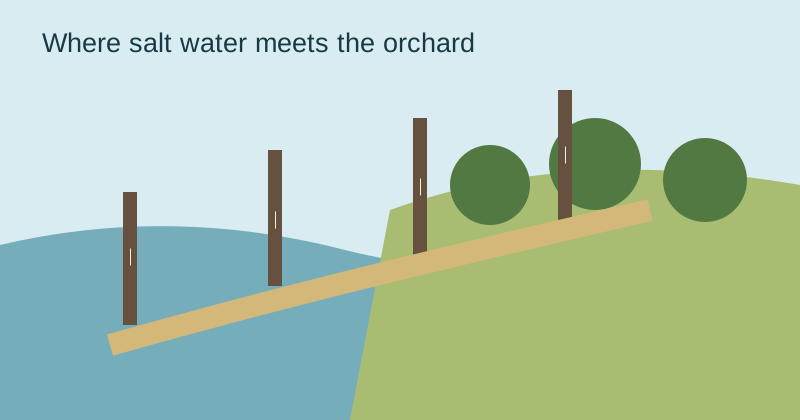
Stimulus 3: "Country records an event long after people choose a date for it."
Framework 2 - Writing about protest Title: The Sign We Turned Around Stimulus 1: "The message changed when we faced it towards the office window." Stimulus 2:
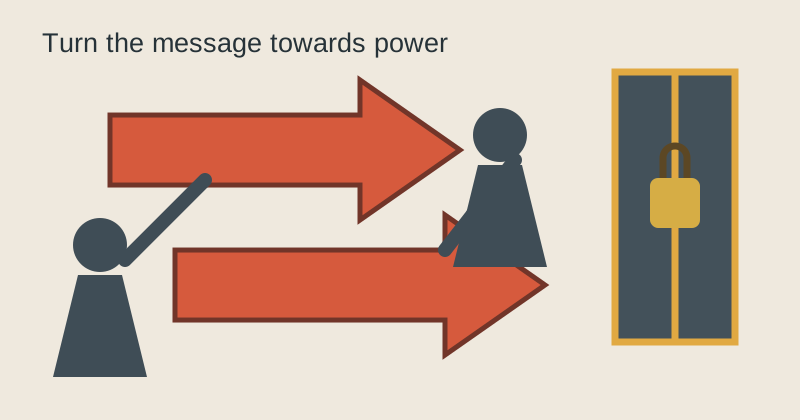
Stimulus 3: "A refusal can be quiet and still leave evidence."
Framework 3 - Writing about personal journeys Title: A Room with Two Clocks Stimulus 1: "At six in the evening, one clock told me to call home and the other told me I was already there." Stimulus 2:
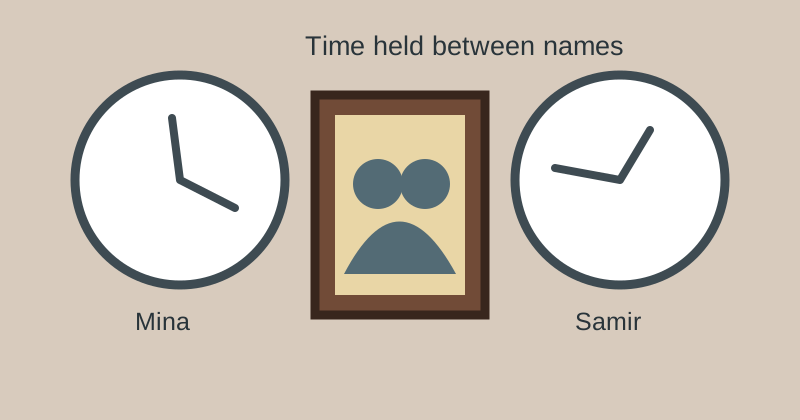
Stimulus 3: "Distance became easier to measure after it stopped meaning separation."
Framework 4 - Writing about play Title: The Rule Under the Table Stimulus 1: "The adults wrote the rules; the children decided when they mattered." Stimulus 2:
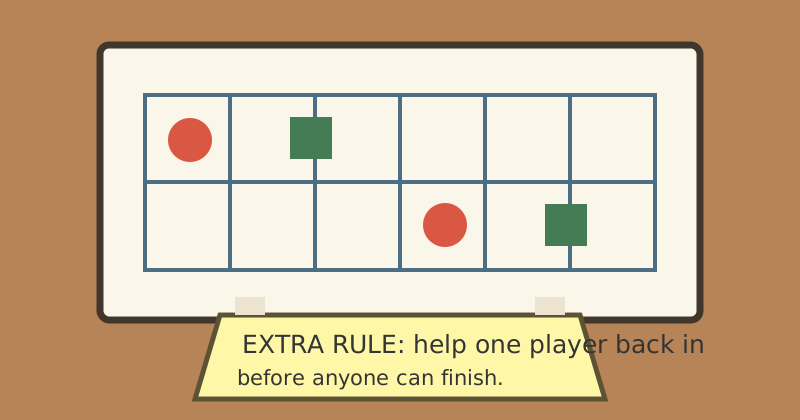
Stimulus 3: "We laughed because the mistake opened a better version."
Section C - Analysis of argument and language
Analyse how contention, arguments, written language and the accompanying visual are used to persuade the intended audience. Support the analysis with precise textual and visual evidence. This section is worth 20 marks.
Question 1
20 marksBackground information
Fictional practice material: All organisations, people, events, statistics and quotations in this Section C material are fictional and were created by Skill Align for examination practice, unless a source is expressly identified. Elmridge Council is considering an eight-week summer trial of a signed "cool route" between the railway station, medical centre and shopping street. Temporary shade panels would cover three exposed sections, and two movable seats and a drinking-water refill point would be added. Mina Sayeed, a community health nurse and Elmridge resident, wrote the following article and chart commentary for the council newsletter.
Make the ordinary walk possible in summer by Mina Sayeed, Elmridge community health nurse
On a mild morning, the nine-minute walk from Elmridge Station to the medical centre is ordinary. At two o'clock on a January afternoon, it can feel like a test. The footpath beside the car park has no shade. The crossing has nowhere to rest. People arrive at the clinic red-faced, or they ask a family member to drive a distance they would usually walk.
Elmridge Council should approve an eight-week cool-route trial between the station, medical centre and shops. Three temporary shade panels would cover the most exposed parts of the path. Two seats could be moved to the places where people actually pause, and the existing tap at Market Corner could gain a bottle-refill fitting. Clear signs would show the route and the distance to the next shaded point.
This proposal is not an air-conditioned tunnel and it will not make a hot day cool. It is a practical attempt to reduce the heat people receive from exposed surfaces and to make rest and water easier to find. A limited trial lets us test whether small changes help before council pays for permanent construction.
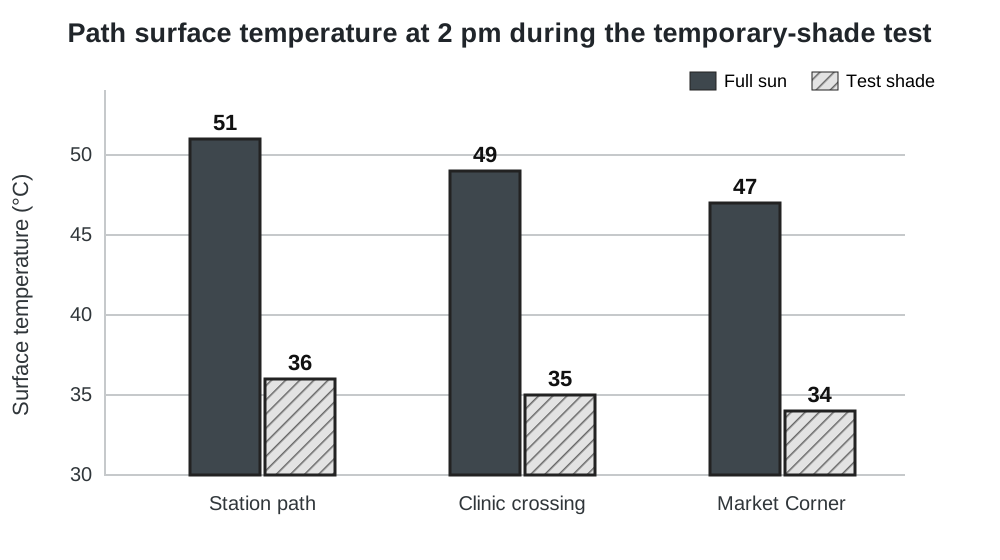
Council's temporary-shade test gives us a useful starting point. On one clear day, staff measured path surfaces at two o'clock in full sun and beneath test shade at the same three locations. The station path measured 51 degrees in sun and 36 under shade. The clinic crossing changed from 49 to 35 degrees, while Market Corner changed from 47 to 34. These are surface readings, not air temperatures, and one day cannot describe a whole summer. Even so, every paired location shows the same direction and a difference of at least 13 degrees.
Cooler surfaces matter because people experience heat from above and below. A person using a walking frame moves more slowly across an exposed path. A parent may wait longer while a child adjusts a bag. A shop worker walking from the station cannot choose a different appointment time. The route would remain useful to faster walkers, but it would be designed around people who cannot simply hurry through discomfort.
Some traders worry that temporary panels will hide their windows or remove parking. They should not. The proposed panels are narrow, open-sided and placed over footpath sections already clear of shop fronts. Installation would occur before trading hours. No parking space would be removed, and the Market Corner seat could be moved during deliveries. Council should publish the exact locations before work begins so traders can identify a practical problem early.
The full trial would cost $24,600, including engineer-certified panels, installation, two seats, signs, the refill fitting and weekly safety checks. That is real public money, so the result must be measured. Council staff would count route users on six hot afternoons, record water use, inspect visibility at the crossing and invite optional comments from pedestrians and traders. At the end of eight weeks, council could remove, change or replace each element with evidence in front of it.
Shade is sometimes discussed as if it were a decoration added after important work is complete. In summer, shade is part of whether public space can be used. A station, clinic and shopping street are only connected when people can move between them safely enough to take part in ordinary life.
Approve the trial. Let us learn where shade, rest and water make a difference, and where they do not. The walk will still be nine minutes on a map. Our task is to make those nine minutes possible for more people.
Accompanying chart A six-bar chart titled "Path surface temperature at 2 pm during the temporary-shade test" pairs a full-sun and test-shade reading for each location. Station path is 51 degrees C in sun and 36 degrees C under test shade. Clinic crossing is 49 and 35 degrees C. Market Corner is 47 and 34 degrees C. The caption states: "Same clear day | surface readings, not air temperature | council test recorded at 2 pm."
Accompanying visual
Sample Responses And Practice Marking Guidance
Section A Question 1
Sample choice: Text 2, Jane Eyre, topic (i)
In Jane Eyre, Jane does not accept that every act called care is truly loving. She learns to judge care by whether another person respects her ability to refuse. At Gateshead, Lowood, Thornfield and Moor House, people offer protection, religion or marriage, but their offers often include a demand for obedience. Brontë shows Jane becoming able to separate care from control.
At Gateshead, Mrs Reed expects Jane to be grateful for food and shelter while denying her fairness and affection. Jane's attempts to defend herself are treated as proof that she is difficult. The red-room punishment teaches her that adults can call control a duty. Her refusal to remain silent does not free her immediately, but it protects her knowledge that injustice does not become right because it comes from a guardian.
Lowood gives Jane other models. Mr Brocklehurst claims that harsh treatment improves children, yet his public humiliation of Jane makes religion a language of power. By contrast, Helen Burns and Miss Temple listen to Jane rather than deciding her character before she speaks. Helen's patience is not exactly Jane's path, but her friendship shows that care can make room for difference. Miss Temple verifies Jane's story and restores her reputation, demonstrating that authority can respond to evidence instead of demanding submission.
Rochester initially attracts Jane because he values her conversation. She can question him, disagree and speak with an honesty that her social position would usually discourage. However, his hidden marriage changes the meaning of his offer. When he asks Jane to stay with him outside marriage, love is joined to secrecy and pressure. Jane's refusal is painful because her feeling is real. Leaving Thornfield shows that the freedom to say no matters most when agreement would be personally comforting.
St John offers a different form of control. He respects Jane's ability and gives her useful work, but his marriage proposal treats her as suitable labour for his mission. He describes refusal as a failure of duty rather than accepting that Jane knows her own emotional limits. His calm language therefore becomes another attempt to replace her judgement with someone else's plan.
Jane can return to Rochester only after her circumstances have changed. Her inheritance gives her material independence, and finding relatives gives her a secure family connection. Rochester has also lost much of the physical and social power he held at Thornfield. Jane's return is now a decision she can make without needing his money or accepting a hidden position. She is able to consent because she is also able to leave.
Brontë does not present independence as living without other people. Jane wants love, work and belonging. What she refuses is a relationship that names obedience as care. By testing guardians, teachers, Rochester and St John, she learns that genuine care listens to an answer it may not want. Her final relationship is possible because her voice, including her power to say no, remains present inside it.
Sample choice: Text 2, Jane Eyre, topic (i). The response explains how Jane tests care through her freedom to refuse rather than treating independence as simple isolation.
Skill Align practice marking guidance — not the official VCAA marking method
Award one holistic mark out of 20. VCAA assessors use the published assessment criteria and interconnected Expected Qualities holistically; fixed criterion submarks are not totalled. The descriptors below are a Skill Align practice aid only.
Text knowledge and understanding
Consider the response's knowledge and understanding of the selected text, its structure, and the ideas, concerns and values raised by the topic.
Selected-topic analysis
Consider how clearly and coherently the response develops analysis of the selected topic.
Textual evidence
Consider how accurately and purposefully close reference and textual evidence support the analysis.
Control of English to convey meaning
Consider organisation, vocabulary, sentence control and conventions according to how effectively they convey analytical meaning.
Holistic marking bands
| Marks | Descriptor |
|---|---|
| 17-20 | Thorough and thoughtful text knowledge; clear consideration of complexities; an insightful, well-supported response to the topic whose controlled English conveys meaning confidently. |
| 13-16 | Careful text knowledge; sustained analysis of the topic with relevant evidence; organised expression and consistent control of English to convey meaning. |
| 9-12 | Clear to satisfactory knowledge; a relevant response with appropriate evidence; generally organised English that conveys meaning despite some errors. |
| 5-8 | Basic or limited text knowledge; partial response to the topic and uneven evidence or organisation; meaning is conveyed in parts. |
| 0-4 | Very limited relevant knowledge or engagement with the topic, with minimal evidence and/or limited control of English. |
Section B Question 1
Sample selection: Framework 3 - Writing about personal journeys; Stimulus 2 A Room with Two Clocks
The first clock came with the room. It was white, square and always three minutes fast. I called it Leena because my housemate Leena believed arriving exactly on time was already late.
The second clock arrived in a parcel from my aunt Nila. It had no numbers, only twelve small blue marks and a note taped to the back: "So you stop calling when I am asleep." I set it to her time and hung it beside Leena's. Between them I pinned a photograph of Nila and me carrying a cake through rain.
At first, the clocks divided every day. When Leena's clock said breakfast, Nila's said that the kitchen at home had been cleaned and the lights switched off. When my classes ended, Nila was beginning work. I became skilled at calculating the narrow hour when neither of us was travelling, studying or sleeping. Missing that hour felt like missing a train that ran only once.
I blamed the distance for small problems. Nila sounded tired because I lived too far away. I forgot a family birthday because the date had changed first on my wall. I learned news after everyone else had already discussed it. The second clock seemed to measure not time but absence.
Then Leena began leaving notes beneath it.
"Nila awake? Ask for the soup recipe."
"Your clock says it is her lunch break. Show her the terrible curtains."
Nila joined our kitchen in a rectangle on my phone. She taught Leena to toast spices without burning them and laughed when our smoke alarm answered. Later, Leena's younger brother moved interstate. A third note appeared: "Can Nila explain how to make a room feel less temporary?"
The clocks had not moved closer, but the room between them had changed. One carried my timetable. The other carried another person's day. The photograph no longer looked like a bridge back to a life I had left. It became one part of a room where several lives could meet.
During daylight saving, I forgot to change Leena's clock. I woke, saw both hands pointing to seven and called Nila in surprise.
"Look," I said, turning the phone towards the wall. "For once we are in the same time."
She laughed. "Only because one clock is wrong."
I reached up to correct it, then stopped. For one minute the mistake was useful. Two clocks showed the same hour while holding different mornings. I understood that the journey had not taught me to choose which time was mine. It had taught me to live responsibly inside more than one.
I moved Leena's clock forward and checked Nila's carefully. The gap returned. It no longer looked empty.
Sample selection: Framework 3, Writing about personal journeys; title: A Room with Two Clocks; Stimulus 2. The reflective narrative turns two labelled clocks into a changing measure of distance and belonging.
Skill Align practice marking guidance — not the official VCAA marking method
Award one holistic mark out of 20. VCAA assessors use the published assessment criteria and interconnected Expected Qualities holistically; fixed criterion submarks are not totalled. The descriptors below are a Skill Align practice aid only.
Framework, title and stimulus ideas
Consider how relevant ideas from one Framework of Ideas, the supplied title and at least one stimulus are connected and developed.
Purpose and cohesion
Consider how clearly the purpose shapes an effective and cohesive complete text.
Structures and language features
Consider how suitable text structures, vocabulary and language features create and develop meaning.
Control of English to convey meaning
Consider control of expression and English conventions according to how effectively they convey the created text's meaning.
Holistic marking bands
| Marks | Descriptor |
|---|---|
| 17-20 | Sophisticated development of framework, title and stimulus ideas; a confident, cohesive text with clear purpose, rich language choices and controlled English that conveys meaning effectively. |
| 13-16 | Thoughtful development of the task elements; a clear, cohesive text whose structures, language features and control of English suit its purpose. |
| 9-12 | Adequate to clear connection to the task elements; an organised text with discernible purpose and suitable language choices; meaning remains clear despite some errors. |
| 5-8 | Basic or limited connection to the title, stimulus or framework; uneven purpose, cohesion or language choices; meaning is conveyed in parts. |
| 0-4 | Very limited engagement with the task, with minimal organisation, awareness of purpose and/or control of English. |
Section C Question 1
Mina Sayeed argues that Elmridge Council should approve an eight-week cool-route trial between the station, medical centre and shops. She presents heat as a barrier to ordinary participation, uses paired surface-temperature readings to show that test shade may help, and answers concerns about cost, businesses and evidence. Her careful limits make the proposal appear responsible rather than exaggerated.
Sayeed changes a familiar nine-minute walk into "a test" on a January afternoon. The contrast between an "ordinary" mild-morning journey and the exposed summer path invites residents to recognise a place they know under different conditions. People arriving "red-faced" or asking for a lift show practical consequences without suggesting every trip becomes a medical emergency. Three panels, two seats, a refill fitting and signs make the trial concrete. Her slightly humorous denial of an "air-conditioned tunnel" rejects unrealistic expectations while asking readers to value a smaller improvement.
The chart supplies the strongest visible evidence. Each location is presented as a pair, so readers can compare the same place in full sun and under temporary shade. Station path falls from 51 to 36 degrees, clinic crossing from 49 to 35, and Market Corner from 47 to 34. The repeated pattern is easy to see, while Sayeed's phrase "at least 13 degrees" summarises the smallest difference rather than selecting only the largest result. This conservative choice makes her analysis appear fair.
Both the article and caption qualify the data: one clear day, surface rather than air readings, all recorded at two o'clock. Sayeed calls this "a useful starting point" instead of proof of how every pedestrian will feel. She then connects the evidence to a person using a walking frame, a parent and a shop worker. These examples widen the benefit, while "cannot simply hurry" challenges residents to judge public space by the needs of people with less choice.
Concerns from traders are treated as reasonable. Sayeed answers them with open-sided panels, no removed parking, installation outside trading hours and a movable seat. Her recommendation that council publish exact locations invites businesses to identify problems before installation. This makes consultation part of the design rather than a promise added at the end.
The exact $24,600 cost prevents the proposal from appearing effortless. Calling it "real public money" leads directly to the evidence council must collect: user counts, water use, crossing visibility and comments. The possible outcomes - remove, change or replace - show that approval does not guarantee permanent construction.
Finally, Sayeed rejects the idea that shade is merely decoration. Places are only connected, she argues, when people can move between them. Repeating the nine-minute journey returns to the opening with a changed meaning: a short line on a map is not automatically accessible. Local experience, qualified chart evidence and safeguards make the trial appear practical, inclusive and accountable.
The sample follows Mina Sayeed's movement from a familiar summer journey to a limited, measurable proposal and explains how the paired chart values support the case without overstating what shade can achieve.
Skill Align practice marking guidance — not the official VCAA marking method
Award one holistic mark out of 20. VCAA assessors use the published assessment criteria and interconnected Expected Qualities holistically; fixed criterion submarks are not totalled. The descriptors below are a Skill Align practice aid only.
Contention, arguments and point of view
Consider the accuracy and depth of understanding of the contention, arguments, point of view and their progression.
Written, spoken and visual analysis
Consider how clearly the response analyses the ways written or spoken language and visuals present arguments and persuade.
Textual and visual evidence
Consider how precisely textual and visual evidence supports analysis of audience positioning.
Control of English to convey meaning
Consider organisation, analytical vocabulary, sentence control and conventions according to how effectively they convey meaning.
Holistic marking bands
| Marks | Descriptor |
|---|---|
| 17-20 | Sophisticated understanding of contention and arguments; complex, precise analysis of written, spoken or visual persuasion; fluent control of English conveys meaning effectively. |
| 13-16 | Strong understanding of argument; sustained analysis of persuasive language and visuals with well-selected evidence; effective control of English. |
| 9-12 | Clear to satisfactory understanding; relevant discussion or analysis of persuasion with appropriate evidence; generally organised English conveys meaning. |
| 5-8 | Some or limited understanding; description or partial analysis with uneven evidence and English control; meaning is conveyed in parts. |
| 0-4 | Very limited understanding of the persuasive material or task, with minimal analysis and/or limited control of English. |
Diagnostic Checklist
| Review focus | Section | Reflection and next action |
|---|---|---|
| Section A — text knowledge | A | Review knowledge of the selected text, its structure, ideas, concerns and values. |
| Section A — selected-topic response | A | Review how directly every part of the analysis responds to topic i or ii. |
| Section A — analytical development | A | Review how claims are extended, connected and explained rather than retold. |
| Section A — textual evidence | A | Review the accuracy, selection and analytical use of close textual reference. |
| Section A — coherence | A | Review paragraph sequence, links and progression across the response. |
| Section A — control of English to convey meaning | A | Review sentence construction, vocabulary and conventions where they affect meaning. |
| Section B — framework, title and stimulus integration | B | Review how the selected framework, supplied title and stimulus actively shape the text. |
| Section B — development of ideas | B | Review whether ideas are extended and connected rather than merely named. |
| Section B — purpose | B | Review how clearly the purpose guides the text's choices and development. |
| Section B — voice | B | Review the consistency and suitability of the created voice. |
| Section B — structure and language choices | B | Review the effectiveness of structure, vocabulary and language features. |
| Section B — cohesion | B | Review links, progression, motifs and the relationship between opening and ending. |
| Section B — control of English to convey meaning | B | Review sentence construction and conventions where they affect the created meaning. |
| Section C — contention and arguments | C | Review the accuracy of the contention, arguments and point of view. |
| Section C — argument progression | C | Review how the response explains the order, development and qualification of the case. |
| Section C — written, spoken and visual analysis | C | Review how persuasive choices are analysed rather than listed or described. |
| Section C — audience positioning | C | Review how effects are connected to the intended audience and persuasive purpose. |
| Section C — evidence | C | Review the precision and integration of textual and visual evidence. |
| Section C — analytical coherence | C | Review paragraph sequence, links and sustained analytical focus. |
| Section C — control of English to convey meaning | C | Review analytical vocabulary, sentence construction and conventions where they affect meaning. |